PLOT of the storied life of aj fikry
The journey to reading The Storied Life of A.J. Fikry for me was already peopled with writers and book lovers the kind of circle this book celebrates. The seed was planted by my mother-in-law, who recommended it after her successful book club discussion. Then, my anticipation was amplified when my uncle gifted it to me, pulled right from my birthday wishlist. These reasons made the novel jump out at me in a way few others do. I knew it was about books, essentially, and that alone was enough to make me think it would be my next lifetime favorite. This story is less about fiction and more about love, grief, and finding second chances, providing an irresistible affirmation of why we read and why we love. It truly aspires to mend your heart. Today, I’m choosing to revisit this old favorite in lieu of reviewing a new release, reflecting on my experience from years ago when I read it before starting this blog.
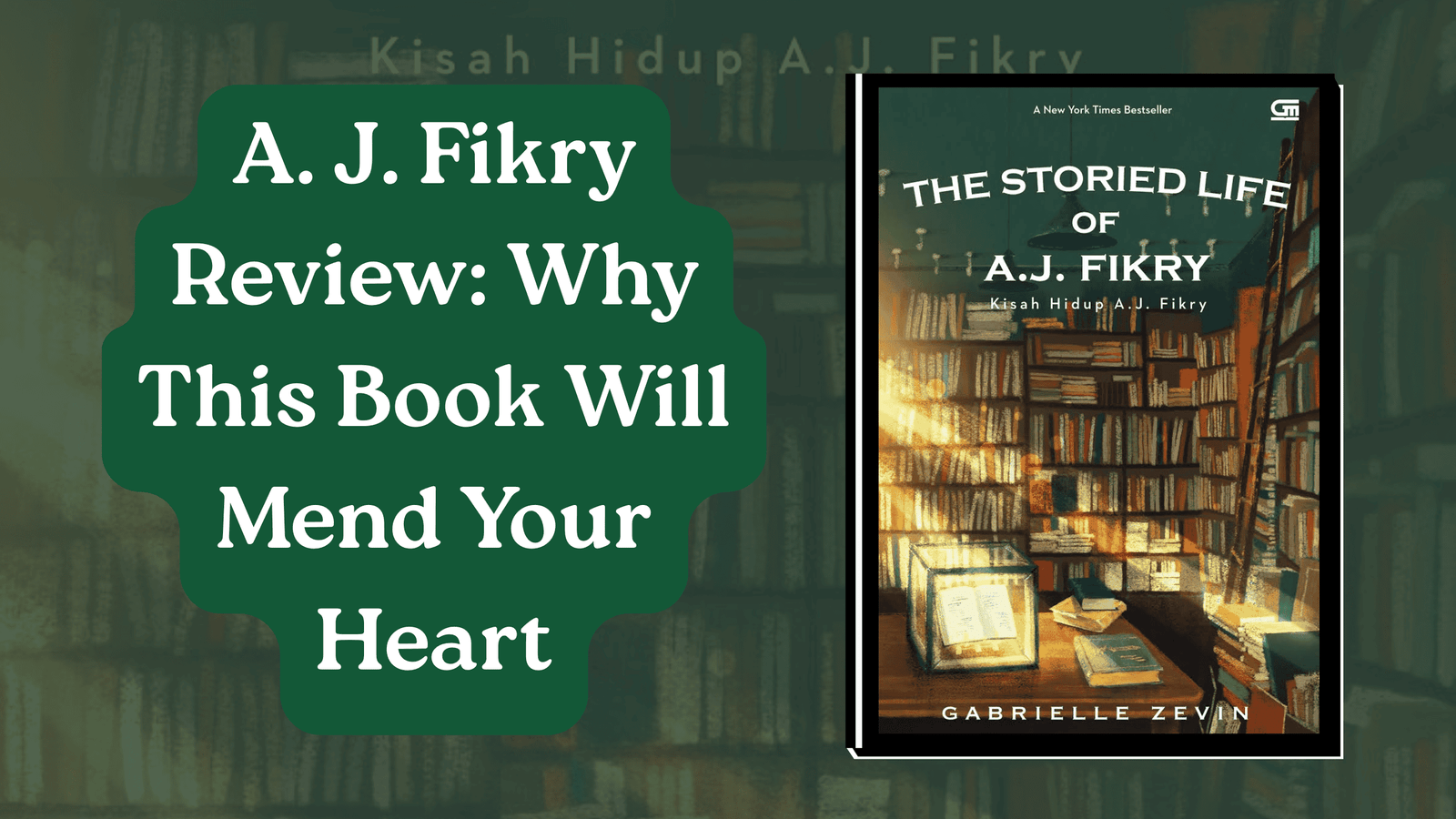
The Storied Life of A.J. Fikry: A Plot of Transformation and Literary Take-Off
The Storied Life of A.J. Fikry, by Gabrielle Zevin, is basically about A.J., the owner of Island Books, an old-fashioned bookstore situated on a small island near Boston. A.J. Fikry lives on this fictional island, which is often referred to as Alice Island off the coast of Massachusetts. The isolated island reflects Fikry’s own mental state when we meet him: a middle-aged, recently-widowed cranky-pants snob living with consuming grief over the loss of his wife to a tragic accident. He’s lonely, drinks to excess, is grumpy and opinionated, and struggles with low book sales in the bookstore that he and his wife bought when they moved to the island.
This is the simple story (in that all lives are simple yet vastly complicated at the same time) of a bookstore owner who has hit rock bottom. One day, while drinking, he decides to take out his prized possession: An invaluable copy of Edgar Allen Poe’s ‘Tamerlane’. He is so drunk he gets sick and passes out. When he awakes the next morning his rare book is missing! Also, suspiciously… his kitchen has been cleaned up. He reports the theft to the police. Complicating this already dire situation, he is rude to a book publisher’s representative, Amelie, when they first meet. Since he now feels that he owns nothing of any real value, he begins to leave his door open when he goes out. Then one day he returns to his bookstore to find that someone has left a baby. The little girl is accompanied only by a brief note and a stuffed Elmo.
This abandoned child will come to forever change A.J.’s life. Maya is a charming, intelligent, beautiful and oh so precocious girl. He lovingly calls her his ‘little nerd’. Another person who will rock his world is Amelie, the publishing sales representative. When first they meet he is bitter and still grieving his wife. He make a less than positive impression. Despite the rough start, over the years, their friendship develops into something more. A.J.’s life is saved by his new found family. There are at least two people in his life who sorta keep him afloat until a few more wander in and we have literary take-off. A bookseller, a police officer, a toddler… they all enter and of course, in the end, save Fikry from himself. Believe it or not, this thin volume covers like fifteen or more years. I think this extremely compressed timeframe might be one of the main issues. If perhaps, Zevin had narrowed in on a more slender time frame and then given some backstory? Even a couple flashbacks? Well… The pace is too fast and slick.
The Structure is the most distinctive literary element: Each chapter is introduced by a story excerpt and brief words of reflection written to his daughter. These poignant notes to his daughter bind the entire story together. Every chapter begins with a note on an actual short story. As a literary reader, I wondered if it would add to my experience to read these short stories as I went. I thought this would make a cool book club project to Read the short story and the chapter for the club meetings. I happened to have the first short story, “Lamb to a Slaughter” by Roald Dahl, in a collection on my bookshelf, so read it before reading the first chapter. While it still might be a good way to book-club this book, it is not necessary for reading it, or even particularly enriching to that experience. The short stories, even the notes on them, didn’t seem to enhance the story in any way. Even what the notes reveal about the plot is a little premature, sometimes. This felt like a technical flourish that didn’t fully pay off, making the execution sometimes lacking.
My personal review is complicated. I think this book is okay a generous okay. Warning, should you think it’s going to be cozy, it totally reads that way except for the swearing and, more to the point, the extremely casual sex. Like sex actually means nothing in this book and middle-aged New Englanders fall into bed easier than the cast of Seinfeld. And yes, They also die off at an alarming rate. I enjoyed reading it, but I was sometimes uncomfortably aware of its faults. What are its faults? It is a little corny. Some people like corny. The characters have very little physical description and then something about them comes out of the blue in like the last chapter. This lack of depth in The story and the characters (at least in their relationship with the reader) means the emotional impact is muted. I didn’t shed a single tear, though I did laugh occasionally because I wasn’t even close to being invested enough, and it wasn’t for a lack of wanting to be. The book’s story is predictable enough that you didn’t even feel the tension of the struggles or pain.
The core character trait of A.J., that of the snob, is also what makes the book a tricky novel to pull off. And perhaps most of all, this is the kind of book that is about a type of genius. All books about a type of genius run an especially high risk of being bad, because the author runs the risk of sounding like they are not the ones to be writing about this type of genius. Or, perhaps, any genius. I mean, Fikry is a high-level snob, so his taste has to be spot-on, and his author would have to be extremely well-read with a very wide knowledge of literature. And then Maya is a most precocious child and throw in a few professional book-nerds. Mostly about Fikry, though, I wasn’t sure I always believed the portrayal of him as a book snob of the highest order. The voice wasn’t trustworthy, to me, but I did see at least one review, I think in the Washington Post, that said Zevin was spot-on with all the titles that she throws around. Maybe I felt untrusting because of the few times the author actually explained a joke, which a man like Fikry would never deign to do, and I thought, oh no you didn’t.
This book attempts to do a lot within its tight framework a framework that is technically strong, if overly neat. The third-person, present tense POV is a choice that makes the setting, too, Very quick and slick, all ‘round. Everything was very neat, very tied up with a big, beautiful bow. While the makings of a great beach read are all there the story itself had great twists and turns I found it to be lacking in execution. I even saw a few reviewers complain about the included short story, which was supposedly a winner of a prize, and I agree that it was odd.
Let’s dissect the core emotional beats, often signaled by the chapter quotes. The feeling of being someone’s “most recent disappointment” on p8 establishes the low bar for acceptance in Fikry’s world. p47 gives us a perfect snapshot of the literary man: “He picked up cross country mainly because he had no skill for any other sport aside from the close reading of texts”. The humor of his transformation starts on p50, noting “A.J. has never changed a diaper in his life, though he is a modestly skilled gift wrapper”. This is contrasted by the hilarious but true observation on p76: “The most annoying thing about it is that once a person gives a shit about one thing, he finds he has to start giving a shit about everything. / No, the most annoying thing about it is that he’s even started to like Elmo”.
The romance isn’t forgotten, just stated plainly on p99: “’I’m a romantic person, but sometimes these don’t seem like romantic times to me’”. Timing is the philosophical driver of the plot, as the police officer says on p104: “’I’ve been a police officer for twenty years now and I’ll tell you, pretty much every bad thing in life is a result of bad timing, and every good thing is the result of good timing”. Fikry’s slow emergence from his shell is noted on p110; “He wants to take a picture, but he doesn’t want to do the thing where you stop to take a picture”, showing he’s trying to live in the moment. The theme of communal happiness is noted on p162 where Ismay wonders, “When did I get so negative, Their happiness is not her unhappiness”. Even Lambiase, hosting the Chief’s Choice Book Club on p201, notes that “the most important thing, even more than the title at hand, is food and drink”. This is a dream world for all us book nerds.
The novel doesn’t shy away from being a love letter to the world of books and booksellers. The debate on commercialism pops up on p216: “’You must keep up with the times,’ she continues. / ‘Why must I, What is so great about the times’”? This is followed by the thought: “From his point of view, the only thing worse than a world with big chain bookstores was a world with NO big chain bookstores. At least the big stores sell book and not pharmaceuticals or lumber”. The central thesis of the heart and words is delivered on p250: “His heart is too full, and no words to release it. I know what words do, he thinks. They let us feel less”. And finally, a great lesson for teachers and parents comes on p254: “’You tell a kid he doesn’t like to read, and he’ll believe you,’ Ismay says”.
The Storied Life of A.J. Fikry did everything a work of fiction aspires to do. It made me think, it made me laugh, it made me weep. I certainly would have chosen this book for me too (no **matter which of the six covers I saw), because it has so much to charm and to snag all us bookish types. But for me, in a strange combination of trying too hard and not trying hard enough, it felt too thin to make me fall in love. And for that assessment, I would like to say sorry to my mother-in-law, who is no doubt reading this review. This isn’t a soul-searching excavation, but a flippant little story that, despite its faults, is Highly Recommended to anyone looking for a literary hug. I wanted to like The Storied Life. There were some moments when I thought, “I like this book”. But there were more moments when I wondered, “Am I just telling myself I should like this book”. I loved the back side of the bookish life, the literary references, the charming New England island life, and most of all the apartment upstairs from a book store! But in the end, all the bells and whistles, including the third-person, present tense POV , didn’t a great novel make. It’s a gem, A little book with a big heart, and that’s enough for my lifetime favorites list.