
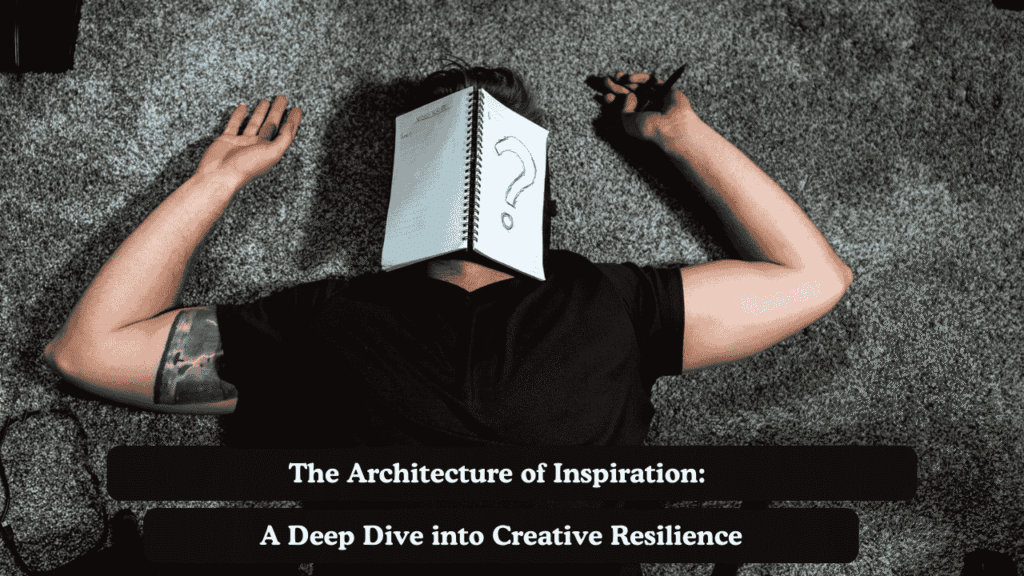
Creative work is a paradox. On one hand, it is the most fulfilling thing a human being can do; on the other, it often feels like dragging a heavy stone up a mountain in the dark. If you have ever sat down to write, paint, or build, and felt a sudden, heavy weight in your chest, you aren’t alone. You aren’t “lazy,” and you haven’t “lost your touch.” You are simply navigating the natural topography of the creative life.
I define creative resilience as the intersection of wellness and production. It isn’t just about working harder; it’s about using your creative powers to strengthen your resolve against life’s challenges. When we feel more creative, our wellness improves and when we feel better, our creativity grows.
To overcome a creative block, we have to stop treating it like a mystery and start treating it like a mechanical problem. In this first part of our exploration, we are going to dive deep into the psychology of why we stop, the difference between fatigue and lack of interest, and the tactical exercises you can use to restart your engines when you are stuck in the middle of a project.
The Anatomy of the Pivot: Strategies for the Mid-Story Slump
There is a specific, agonizing moment in every project usually around the 50% mark where the initial “spark” of the idea has burned out, but the warmth of the finish line is still too far away to feel. This is the “corridor of doubt.” You have committed enough time to feel the pressure of failure, but you haven’t yet found the path to the end.
When you are stuck here, the most common mistake is to keep trying to “force” the next logical step. If the logic isn’t working, the problem isn’t your effort; it’s your perspective. To get moving again, you need to break your own rules.
The “Point of No Return” Exercise
When a story or a business plan feels stuck, I often use the “Catastrophe Method.” Ask yourself: What is the worst possible thing that could happen to my current progress right now? In a story, maybe a character dies unexpectedly. In a business plan, maybe your primary funding source disappears. Write a page about that disaster.
By forcing a crisis, you demand that your brain solve a new, more urgent problem. This bypasses the boredom of the “middle” and forces you back into a state of high-stakes creativity. You might not keep the disaster in the final draft, but the energy you generate while solving it will carry you through the next several chapters.
The Dialogue-Only Sprint
Often, we get stuck because we are over-complicating the “connective tissue” of our work the descriptions, the transitions, the formal structures. If you find yourself staring at a blinking cursor, strip everything away except the core interaction. If you’re writing a book, write only the dialogue for the next three scenes. Don’t worry about who is standing where or what the room looks like. Just capture the “heat” of the conversation. By narrowing your focus, you reduce the mental load, making it easier to start moving again.
Diagnosing the Engine: Burnout vs. Boredom
Before you can fix a creative block, you must accurately diagnose the cause. I see many creators try to “hustle” through burnout, which is like trying to drive a car with a melted engine. Conversely, I see people “rest” because they think they are burnt out, when they are actually just bored.
Understanding Burnout
Burnout is a physiological and emotional state of depletion. It isn’t just “being tired.” It is a sense of dread. If looking at your laptop makes you feel physically nauseous or deeply anxious, you are likely facing burnout.
- The Cause: Prolonged stress, lack of sleep, or working on a project that violates your personal values.
- The Cure: Silence and distance. You cannot fix burnout by “thinking” about your project. You fix it by going for a walk, sleeping ten hours, and not looking at a screen for two days.
Sometimes, the cure for burnout is reconnecting with the ‘why.’ Look at your work as a form of advocacy. Are you solving a problem for someone else? When we use our creative resilience to help others even in small ways it can actually act as a healing mechanism for ourselves.
Understanding Boredom
Boredom is much more dangerous because it disguises itself as fatigue. Boredom happens when your work has become too safe. You aren’t challenged. Your brain has figured out the pattern and is now “tuning out.”
- The Cause: Repetition, lack of risk, or following a formula too strictly.
- The Cure: Radical change. Boredom requires “heat.” You need to introduce a new element that scares you or excites you.
If you are bored, rest will not help. In fact, rest will make the boredom worse. If you are bored, you need to turn up the volume, increase the stakes, and do something that feels slightly “wrong” for the project.
The Silent Enemy: Mastering the Concept of Resistance
In The War of Art, Steven Pressfield introduces us to Resistance. This is not just a lack of motivation; it is an active, malevolent force that works against our growth. Resistance is the reason you decide to clean the bathroom at 11:00 PM instead of finishing your final paragraph.
Resistance is a Compass
The most important thing I have learned about Resistance is that it is actually a guide. Resistance is only felt toward things that are important to us. You don’t feel Resistance toward watching Netflix or eating a snack because those things don’t require you to grow. You feel Resistance toward your painting, your book, or your startup because those things require you to step into a higher version of yourself.
Therefore, the more Resistance you feel, the more certain you can be that the project is worth doing. When you feel that heavy, sinking feeling of “I can’t do this today,” you should interpret that as a signal: “This is exactly what I must do today.”
Moving from Amateur to Professional
The difference between a hobbyist and a professional is how they handle Resistance. The amateur waits for the feeling of Resistance to go away before they work. The professional knows that Resistance never goes away.
To beat it, you must develop a ritual of arrival. For me, it is making a specific cup of tea and putting on noise-canceling headphones. These physical cues tell my brain, “We are entering the workspace now. The Resistance is here, but we are working anyway.” You don’t need to defeat Resistance; you just need to outlast it for the next few hours.
Clearing the Mental Debris: The Power of Freewriting
One of the primary causes of a block is “mental fog” a clutter of unrelated thoughts that occupy the bandwidth you need for your work. You are trying to write, but you are also thinking about an email you forgot to send, a comment someone made on social media, or what you’re going to eat for dinner.
The Brain Dump
Freewriting is the practice of clearing your “mental cache.” Set a timer for 15 minutes. During this time, you must not stop writing. You aren’t writing for an audience; you are writing for the trash can.
Write down every petty thought, every worry, and every “to-do” item that is circling your mind. By putting these thoughts on paper, you effectively “save” them and close the tab in your brain. Once the fog is cleared, you will find that the creative thoughts, which were buried underneath the clutter, begin to float to the surface.
Using Freewriting for Problem Solving
If you are stuck on a specific part of your story, use freewriting to interview yourself. Write: “Okay, I’m stuck here because…” and then let your hand answer. Often, your subconscious knows exactly what the problem is, but your conscious, “professional” mind is too busy trying to be perfect to listen. Freewriting gives that subconscious voice a megaphone.
The Architecture of the Mind: Part Two Overcoming the Fraud Within and Building Creative Durability
As we move deeper into the creative process, the challenges shift from the mechanical to the internal. In the first part of this guide, we looked at how to clear the “mental fog” and identify the enemies of our focus. Now, we must address the most sophisticated barrier of all: the belief that we don’t belong in the room. This second phase of our journey focuses on the psychological resilience needed to sustain a long-term creative career.
The Silent Saboteur: Techniques for Overcoming Imposter Syndrome
Even after years of success, many creators are haunted by a persistent voice that whispers, “You’re just lucky,” or “Soon, everyone will realize you have no idea what you’re doing.” This is Imposter Syndrome. It isn’t a sign of weakness; rather, it is a byproduct of high standards. You only feel like an imposter because you are reaching for a level of excellence that you haven’t fully mastered yet.
The “Evidence File” Strategy
When your mind tries to convince you that you are a fraud, you cannot fight it with vague “positive thinking.” You must fight it with data. I keep a physical or digital folder called the “Evidence File.” Inside, I store screenshots of positive feedback, completed project milestones, and notes on difficult problems I have solved in the past. When the feeling of being a “fake” hits, I open this file. It serves as a cold, hard reminder that my presence here is based on a history of work, not a lucky break. It shifts the conversation from feeling (which is subjective) to fact (which is objective).
Reframing the “Fraud” Narrative
Instead of trying to eliminate Imposter Syndrome, try to reframe it as “The Growing Pain of the Soul.” If you never felt like an imposter, it would mean you were playing it too safe. You would be working well within your comfort zone, repeating things you already know how to do.
Feeling like a fraud is actually a signal that you are playing in a bigger league. It means you have stepped onto a stage that challenges you. When I feel that familiar sting of insecurity, I tell myself: “Ah, this is the feeling of growth. I am uncomfortable because I am becoming someone new.” By welcoming the feeling, you strip it of its power to paralyze you.
Deepening the Practice: The Professional’s Ritual
As we discussed in the context of Steven Pressfield’s The War of Art, the professional does not wait for inspiration. However, being a professional requires more than just “showing up.” it requires a structured environment that protects your creative energy.
The Sacred Space and Time
Resistance loves ambiguity. If you sit down at your desk and ask yourself, “What should I work on today?” you have already lost. You have given Resistance an opening to suggest checking your email or browsing social media.
The professional eliminates choice. I recommend a “Pre-Flight Checklist” for your creativity:
- Physical Cue: Light a specific candle, put on a specific playlist, or clear your desk of everything except your tools.
- The Intentional Start: Know exactly what your first sentence or first task is before you sit down. I often stop my work mid-sentence the day before. This makes it incredibly easy to start the next morning because I just have to finish the thought.
- Cultivate Equanimity. This is the practice of accepting when efforts go wrong or turn out imperfectly. A professional doesn’t just show up; they give themselves permission to make mistakes. Make space for the work to be ‘messy’ and extend that same grace to yourself that you would to a friend.
- The Technology Ban: The phone is the primary delivery system for Resistance. It must be in another room.
By automating the “start” of your work, you bypass the part of your brain that wants to argue about whether you are “in the mood” or not.
Advanced Freewriting: Excavating the Subconscious
In the previous section, we used freewriting to clear “mental fog.” Now, let’s look at how to use it as an excavation tool for when your project feels shallow or disconnected.
The “Interrogation” Technique
When a story or project feels “flat,” it’s often because you are writing from your conscious mind rather than your gut. To fix this, use freewriting to interview your work. Ask the project itself a question: “Why do you feel so boring right now?” Then, write the answer as fast as possible. Don’t think; just let the words flow. Often, you will find yourself writing things like, “I’m boring because you’re afraid to let the main character be vulnerable,” or “I’m boring because this solution is too easy.” This type of freewriting bypasses your “Internal Critic”—the part of you that wants the work to be “good” or “proper.” Your subconscious doesn’t care about being proper; it only cares about being true. This truth is what ultimately dissolves creative blocks.
The Sustainability of the Creative Engine
A major reason we hit “the wall” is that we treat our creativity like a bank account we can withdraw from infinitely without ever making a deposit. To avoid the transition from boredom into genuine burnout, you must curate your “inputs.”
The “Creative Well” Concept
Julia Cameron, author of The Artist’s Way, speaks about “filling the well.” If you only spend time in front of your screen, your “well” of images, experiences, and emotions runs dry.
To maintain a 1,000-word-a-day pace or finish a 3,000-word article, you need a surplus of material. This means:
- Intentional Observation: Go to a public place and just watch people. How do they walk? How do they hold their coffee?
- Reading Outside Your Field: If you are a business writer, read poetry. If you are a novelist, read biology textbooks. New connections create new sparks.
- Physical Movement: I have found that my best breakthroughs happen when I am walking, not when I am sitting. Movement in the body often translates to movement in the mind.
Summary of the Middle Path
At this stage, we have moved from the “emergency” tactics of breaking a block to the “infrastructure” of maintaining flow. We have learned that:
- Imposter Syndrome is a sign of high standards and should be managed with evidence and reframing.
- Rituals protect us from the daily attacks of Resistance.
- Freewriting can be a scalpel used to cut through the surface-level fluff of a project to find the “heat” underneath.
- Filling the Well is a non-negotiable requirement for long-term production.
The Architecture of the Mind: Part Three The Final Push and the Art of Completion
We have reached the most dangerous part of the journey. In the previous sections, we built the foundation and navigated the messy middle. Now, we face the final “Boss” of the creative process: the fear of finishing. It is one thing to start a project with high hopes; it is quite another to put your name on it and release it into the world. In this final 1,000-word segment, we will synthesize our strategies and look at how to cross the finish line while keeping the demons of doubt at bay.
The Final Boss: Resistance at the Finish Line
In The War of Art, Steven Pressfield warns that Resistance is most powerful and most malicious right at the end. When you are 90% finished, the internal voice doesn’t just whisper; it screams. It tells you that the work is rubbish, that the ending is weak, or that you should start over from scratch.
The “Ship It” Mindset
To beat Resistance in the final hours, you must adopt the mindset of a “Finisher.” This is the point where you stop being an artist and start being an editor.
- The Perfectionism Trap: Perfectionism is just Resistance in a fancy suit. It is a way to stay “safe” by never finishing. If you never finish, you can never be judged.
- The “Good Enough” Standard: I often tell myself, “This doesn’t have to be the best thing ever written; it just has to be the best thing I can do today.” By lowering the stakes, you actually allow yourself the freedom to perform better.
Using Freewriting to Solve Final-Act Knots
If you are struggling to wrap up your thoughts, go back to your freewriting tool. Ask yourself: “What is the one thing I want the reader to feel when they close this?” Don’t worry about the wording. Just get the emotion down. Once you have the emotional target, the technical words will follow. This “clearing of the fog” is essential when you are too close to the work to see it clearly.
Navigating the Emotional Aftermath: Post-Project Imposter Syndrome
Even after you hit “send” or “publish,” the battle isn’t over. A new wave of Imposter Syndrome often hits the moment the work is out of your hands. This is known as the “Vulnerability Hangover.”
The “Done is Better Than Perfect” Mantra
The most successful people I know aren’t the most talented; they are the ones who finish things. Every time you finish a project, you are building “Creative Capital.” You are proving to your subconscious that you are a person who follows through.
When the voice of the imposter returns to tell you that you “got away with it this time,” look back at your Evidence File. Remember that the struggle you went through the mid-story slumps, the burnout scares, the bored afternoons is the price of admission. You didn’t “get away” with anything; you paid for this work with your time and emotional labor.
Integrating the 5 Pillars into a Creative Lifestyle
To ensure you never face a permanent creative block again, you must integrate the five cluster topics we’ve discussed into a daily rhythm. This isn’t just about finishing one article; it’s about building a career.
1. The Daily War (Resistance)
Expect the Resistance every morning. Don’t act surprised when you don’t feel like working. Treat it like the weather it’s just something you work around. Use your rituals to signal the transition from “human being” to “creative professional.”
2. The Mid-Story Pivot (Exercises)
Keep your toolbox of exercises ready. If a project feels stuck, don’t walk away immediately. Try a “What If” inversion or a “Dialogue-Only” sprint first. Often, the block is only an inch deep, and one good exercise can break through it.
3. The Energy Audit (Burnout vs. Boredom)
Once a week, check in with your energy levels. Are you exhausted (Burnout) or just uninspired (Boredom)? Be honest. If you are burnt out, take the weekend off no exceptions. If you are bored, find a way to make your current project more “dangerous.”
4. The Mental Cache (Freewriting)
Make freewriting a non-negotiable part of your morning. Ten minutes of “brain dumping” can save you two hours of staring at a blank screen later in the day. Clear the fog before you try to navigate the path.
5. The Identity Shift (Imposter Syndrome)
Stop trying to “feel” like an expert. Focus on acting like one. The more you do the work, the more the feeling of being an imposter will fade into the background. It may never disappear completely, but it will eventually become a quiet hum rather than a deafening roar.
Don’t go it alone. While the work happens in private, resilience is built in community. Cultivate a network of supportive peers. By being vulnerable and sharing your ‘stuck’ moments with others, you realize that the Weight in your chest is a universal experience. A supportive community can often carry you through the last 10% when your own strength fails.
Conclusion: The Professional’s Path
We have covered 3,000 words of strategy, psychology, and practical tactics. From the initial spark to the final period, the creative process is a journey of self-discovery. A creative block is not a wall; it is a door that requires a specific key.
Whether you are using freewriting to clear your head, or studying The War of Art to understand your inner critic, the goal is always the same: to keep the channel open. Your voice is unique, your perspective is needed, and the only way to fail is to stop.
The next time you feel that heavy weight of a “block,” don’t panic. Smile. It means you are about to do something important. It means you are a creator. Now, take a deep breath, set your timer, and write the next word.
The Final Boss: Resistance at the Finish Line
In The War of Art, Steven Pressfield warns that Resistance is most powerful and most malicious right at the end of a project. When you are 90% finished, the internal voice doesn’t just whisper; it screams. It tells you that the work is rubbish, that the ending is weak, or that you should start over from scratch. This is a “block” disguised as high standards.
The “Ship It” Mindset
To beat Resistance in the final hours, you must adopt the mindset of a “Finisher.” This is the point where you stop being an artist and start being an editor.
- The Perfectionism Trap: Perfectionism is just Resistance in a fancy suit. It is a way to stay “safe” by never finishing. If you never finish, you can never be judged.
- The “Good Enough” Standard: I often tell myself, “This doesn’t have to be the best thing ever written; it just has to be the best thing I can do today.” By lowering the stakes, you actually allow yourself the freedom to perform better.
Navigating the Emotional Aftermath: Post-Project Imposter Syndrome
Even after you hit “send” or “publish,” the battle isn’t over. A new wave of Imposter Syndrome often hits the moment the work is out of your hands. This is known as the “vulnerability hangover.” You feel exposed, and you are certain that everyone is about to realize you were “faking it” the whole time.
The “Evidence File” for the Long Haul
The most successful people I know aren’t necessarily the most talented; they are the ones who finish things consistently. Every time you finish a project, you are building “Creative Capital.” You are proving to your subconscious that you are a person who follows through.
When that voice of the imposter returns, look back at your physical folder of “wins.” Remember that the struggle you went through the mid-story slumps, the burnout scares, the bored afternoons is the price of admission. You didn’t “get away” with anything; you paid for this work with your time and emotional labor. Over time, the evidence becomes too loud for the imposter to ignore.
Sustaining the Engine: Integrating the 5 Pillars
To ensure you never face a permanent creative block again, you must integrate our five cluster topics into a daily rhythm. This turns a “tactic” into a “habit.”
1. Anticipating the War (Resistance)
Expect Resistance every morning. Don’t act surprised when you don’t feel like working. Treat it like the weather it’s just something you work around. Use your rituals (the coffee, the specific music, the clean desk) to signal the transition from “human being” to “creative professional.”
2. Mastering the Pivot (Exercises)
Keep your toolbox of mid-story exercises ready. If a project feels stuck, don’t walk away immediately. Try a “What If” inversion or a “Dialogue-Only” sprint first. Often, the block is only an inch deep, and one good exercise can break through it.
3. The Energy Audit (Burnout vs. Boredom)
Once a week, check in with your energy levels. Are you exhausted (Burnout) or just uninspired (Boredom)? Be honest.
- If you are burnt out, you need total rest.
- If you are bored, you need to take a bigger risk in your work. Confusing the two is the fastest way to kill a career.
4. The Mental Cache (Freewriting)
Make freewriting a non-negotiable part of your morning. Ten minutes of “brain dumping” can save you two hours of staring at a blank screen later in the day. Clear the fog before you try to navigate the path. Think of it as stretching before a marathon.
5. Owning Your Seat (Imposter Syndrome)
Stop trying to “feel” like an expert. Focus on acting like one. Confidence follows action, not the other way around. Every word you write is a vote for the person you want to become.
Final Thoughts: The Professional’s Path
We have now covered the full spectrum of creative resilience. From the initial spark to the final period, the creative process is a journey of self-discovery. A creative block is not a wall; it is a door that requires a specific key. Sometimes that key is a rest, sometimes it is a radical change in the story, and sometimes it is simply the discipline to sit in the chair until the Resistance gives up.
Whether you are using freewriting to clear your head or studying the psychological warfare of The War of Art, the goal is always the same: to keep the channel open. Your voice is unique, your perspective is needed, and the only way to fail is to stop.
The next time you feel that heavy weight of a “block,” don’t panic. Smile. It means you are about to do something important. It means you are a creator. Now, take a deep breath, set your timer, and write the next word.





1 thought on “The Architecture of Inspiration: A Deep Dive into Creative Resilience”